New construction emissions are a small part of the puzzle
- Any new-construction pipeline cannot meaningfully reduce portfolio emissions when roughly 80% of the buildings that will exist in 2050 are already standing (Chang, Fornara & Sanghvi, Harvard Kennedy School, 2024). Operational savings from new projects marginally reduce portfolio emissions, while their embodied carbon adds to Scope 3 emissions.
- New construction project teams face tight budgets, strict schedules, and risk aversion. When evaluating low-carbon alternatives like thermal energy storage or low-GWP refrigerants, owners need precedents for decision making and contractors price in uncertainty. Individual projects left to innovate must move mountains to succeed, and they still may not generate precedents. Precedents that can be widely applied are most effectively engineered at the portfolio level.
Organizations typically navigate three steps:
- Rung 1 - Compliance Tracking: Measuring emissions strictly to satisfy reporting requirements, yielding some reactive action items.
- Rung 2 - Project-by-Project Pipelines: Funding sustainability in new builds. These projects face the risk of budget squeezes, while taking on the pressure for precedent generation.
- Rung 3 - Portfolio Strategy: Sequencing and financing innovation across the entire asset base, recycling capital out of laggards into high-performing assets and acquisitions so individual projects do not bear the burden alone.
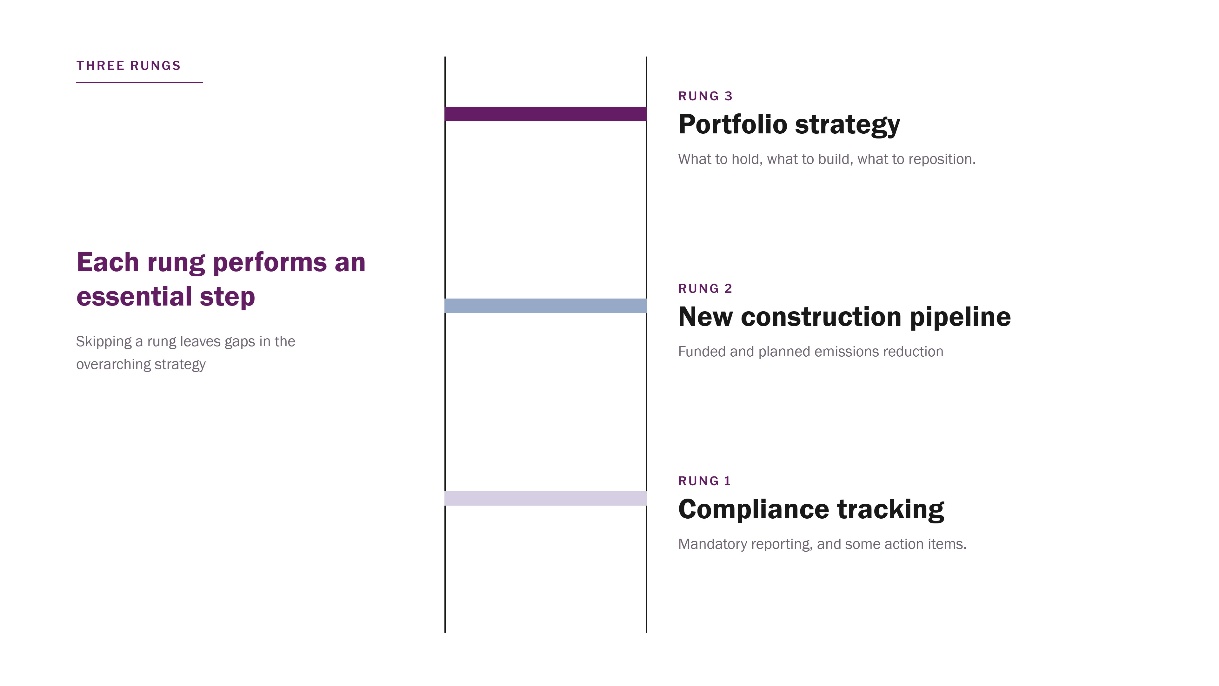 Three rungs of emissions reduction maturity. Organizations at rung three must use creative cross-disciplinary strategies to amplify effect.
Three Questions for Organizations
- Does your retrofit budget survive the ups and downs of capital planning, or does it get raided first?
- Can you name the ten worst-performing assets by carbon intensity and climate risk intensity without commissioning a study?
- Does a low-carbon spec proven on one project become the default on the next, or does it get re-argued from scratch?
Decarbonizing at the portfolio level is not a bigger version of doing it project by project:
- This is where lower-GWP limits for high-carbon materials, procurement criteria that local suppliers can meet, a pre-vetted vendor list of low-GWP equipment, centralization of loads, and financing get built for quick, easy deployment on new and existing projects.
- Financing becomes structurally possible through: C-PACE loans for envelope and HVAC, green bonds where large-scale aggregation is possible, and an internal carbon fund to pay for projects that do not have a budget. Bonus: these are all worth a conversation with lenders and insurers to lower the cost of insurance and debt.
Portfolio strategy sets off a domino effect: embodied-carbon procurement, retrofit financing, and climate-risk management start compounding once one decision runs through all three.